“We could build this ourselves.” You could. Ask anyone who did.
A deal context layer is a connector for every system a deal touches, an opportunity-level data model, and evaluation work that never finishes. Opine is that layer already running: connected in a day, current on its own, and read by your CRM, your forecast and whatever AI you run.
MIT’s State of AI in Business 2025: “External partnerships see twice the success rate of internal builds”. MIT NANDA · July 2025 (opens in a new tab)
Used by the world's leading companies
Should you build a deal context layer in-house or buy Opine?
For most revenue orgs, buy. The layer is a pipeline into every system a deal touches, an opportunity-level data model, and evaluation work that never ends. Opine runs all three today, connects in a day, and serves the record to your CRM, your forecast and any AI you run.
In-house
A project: connectors, a deal model, an eval harness, and an owner forever.
Who reads it
- The build team
- The pilot users
Opine
The deal context layer built for your entire revenue org.
Who reads it
The first year, on both plans
Every date below is published: the build track runs on the floors from our own estimate model, and the buy track on what a connect does the same day. Best case against best case.
Connect read-only. The first deals assemble by the afternoon.
Fields fill, the forecast reads it, updates land in Slack.
History across, templates set, the whole org run in.
Current on its own. Model churn is our roadmap, not yours.
Twelve months in
A year of cited answers behind you, and no engineer ever joined a standup.
Kickoff. Two engineers come off the product roadmap.
Connectors, schema, eval harness: eighteen engineer-months at the floor.
Best case for a first answer anyone trusts.
Upkeep begins: four engineer-months a year, at the floor.
Twelve months in
The layer is three months old, and the upkeep line just opened.
The dates above are the floors of the estimate model behind our Build vs. Buy Assessment, which shows each figure to you as a ±20% range around your own answers.
Both plans end with a context layer. One of them spends the year without it, and that year is the line the build estimate never itemizes.
The research says the same thing
Five research organizations have published on how internal AI efforts fare. None of them sells a context layer. Every card links to the source.
2×
the deployment rate of external partnerships against internal builds in the report's sample: ~67% reached deployment, against ~33%.
MIT NANDA · July 2025
The GenAI Divide: State of AI in Business 2025 (opens in a new tab)0%
of generative AI projects predicted to be abandoned after proof of concept by the end of 2025, for data quality, costs or unclear value.
>0%
of AI projects fail, by the report's estimate: twice the failure rate of IT projects that don't involve AI.
0%
of companies abandoned most of their AI initiatives in 2025, up from 17% a year earlier. The survey is subscriber-gated, so this links the coverage.
S&P Global · via CIO Dive · March 2025
AI project failure rates are on the rise: report (opens in a new tab)0%+
of organizations report no material impact on enterprise-level EBIT from generative AI, even as 78% use AI in at least one function.
What you'd actually be signing up for
Described, not scored. Your team could build every row on this table. Each cell says what the row takes, so you can price the whole thing before the kickoff instead of after it.
Calls, Slack threads, CRM edits and docs land on the deal on their own. A Mac app catches the calls your recorder misses.
See how it works: Capture from every sourceOne connector per system, each with its own auth, rate limits and release notes. Reaching a source once is the easy half. Keeping six connected is the job.
Everything normalizes into one opportunity-level record: what was promised, what's blocked, which criteria the buyer signed off, who stopped replying.
See how it works: A deal model, not a document pileThe schema is the hard part: turning a transcript and a thread into deal state a forecast can rest on. No framework ships it. It's bespoke every time.
An MCP server over live deal context. Point Claude, ChatGPT or your own agent at it and it reads the deal as it stands right now.
See how it works: Readable by the AI you already runRetrieval, permissions and an interface per assistant. Search over transcripts is the version most builds ship, and it answers like a search box.
Agent output is scored against human-labeled ground truth, drift is tracked, and edge cases feed back in. Owning that is the product you're buying.
See how it works: Correctness, ownedAn eval harness, labeled data and a named owner. Skip it and you learn about wrong answers from the rep who stopped trusting them.
Models improve and APIs deprecate underneath Opine. Absorbing that is our roadmap, so it never appears on yours.
See how it works: Model and API churnEvery upgrade, deprecation and prompt regression lands on the engineers who built it, whatever else they were shipping that sprint.
New stages, new products, new templates: configuration you change once, not code.
See how it works: When your sales process changesEach process change reopens the build. The fix queue competes with your product roadmap every quarter, and the roadmap usually wins.
Connect read-only and the first deals assemble the same day, with every answer citing the sources it read.
See how it works: Time to the first trusted answerData first, model second, interface third. Our public estimate puts the best-case first trusted answer around nine months out.
RevOps, the forecast, the reps and customer success from the first week, in the tools they already use.
See how it works: Who it serves in the meantimeThe pilot team, once there's a pilot. Everyone else keeps working the old way while the problems the build was approved to fix keep running.
The record follows the account into onboarding, renewal and expansion, and the same layer serves the next team without a phase two.
See how it works: After it shipsVersion one was specced for one workflow. The first request after launch comes from a team it wasn't built for, and the backlog starts.
Compiled from the build estimate behind our public Build vs. Buy Assessment, verified 1 September 2026. Spot something out of date? Tell us and we’ll fix it.
Still tempted? Run your own numbers.
A free, self-serve assessment: fifteen questions on your team, your data reach and your appetite for upkeep, scored on the page with no call attached. You leave knowing whether a build is even worth it for your org, with the bill in engineer-months and an answer you can defend in the meeting.
What building it sounds like from the inside
Engineers in public threads, a CIO and a data scientist in the research interviews, an analyst on the record. Different rooms, same arc. Unedited, and every card links to where it was said.
“95% of organizations are getting zero return”
The prototype was the easy part, the data wasn't what anyone thought, someone has to own it, and the people writing the checks are out of patience. Your engineers aren't the problem. The year is.
See the already-built version on your deals
Connect read-only and the first deals assemble the same day. Bring the deal your build was specced around.
What closing it gives back
Averaged across the revenue teams already running on Opine.
The team you don't have to hire
A build serves its first users when the backlog clears. These five start reading the layer the same week one person connects it.
The only setup
One Opine power user can empower an entire enterprise in a day.
- Connect Salesforce, Slack and your recorder
- Set your plan templates once
- Switch on the agents and MCP
In the forecast review
CRO
Your forecast stops being a survey in week one, not in year two
In Salesforce
RevOps
Your fields fill from the call that just happened, and nobody wrote the pipeline that fills them
In Slack
Account executives
You see what changed since Thursday in your channel, and it never needed a build ticket
On the account
Customer success
You inherit every promise the deal was won on, without waiting for a phase two
In Claude or ChatGPT
Anyone with a question
You ask in plain English and get cited answers from an interface nobody had to build
No job req, no sprint zero, no bus factor. The layer's engineering team is ours, the people it serves are yours. In our experience the person who connects it gets remembered for it, too: the value shows up across every revenue team at once, and more than one champion has been promoted with the rollout on their review.
Bring the person who’d own it.
Already mid-build? What switching costs
The sprints you've spent aren't wasted. What you learned about your own process ports. The plumbing doesn't have to.
Keep your CRM and your stack
Opine connects to Salesforce or HubSpot, Slack, your recorder and your docs. Read access is enough to start and the first deals populate the same day.
- Plan a week
Bring your history across
Closed and open opportunities come across with their activity. Mid-build teams know this step by name: it is the backfill from your own board. Plan a week, not an afternoon, if the reporting should be right on day one.
Port the thinking, not the prompts
Your templates, your criteria, the questions the build was meant to answer: we rebuild those with you. The prompt library stays behind.
Point your AI at it
Turn on the MCP server and Ask Opine. The agents the build was for start reading a finished record. That was the point all along.
We’ll scope it against your actual systems, not a template.
Rated by the people who live in it
Across account management, engineering operations and the field. Not only the presales team that runs the evaluation.
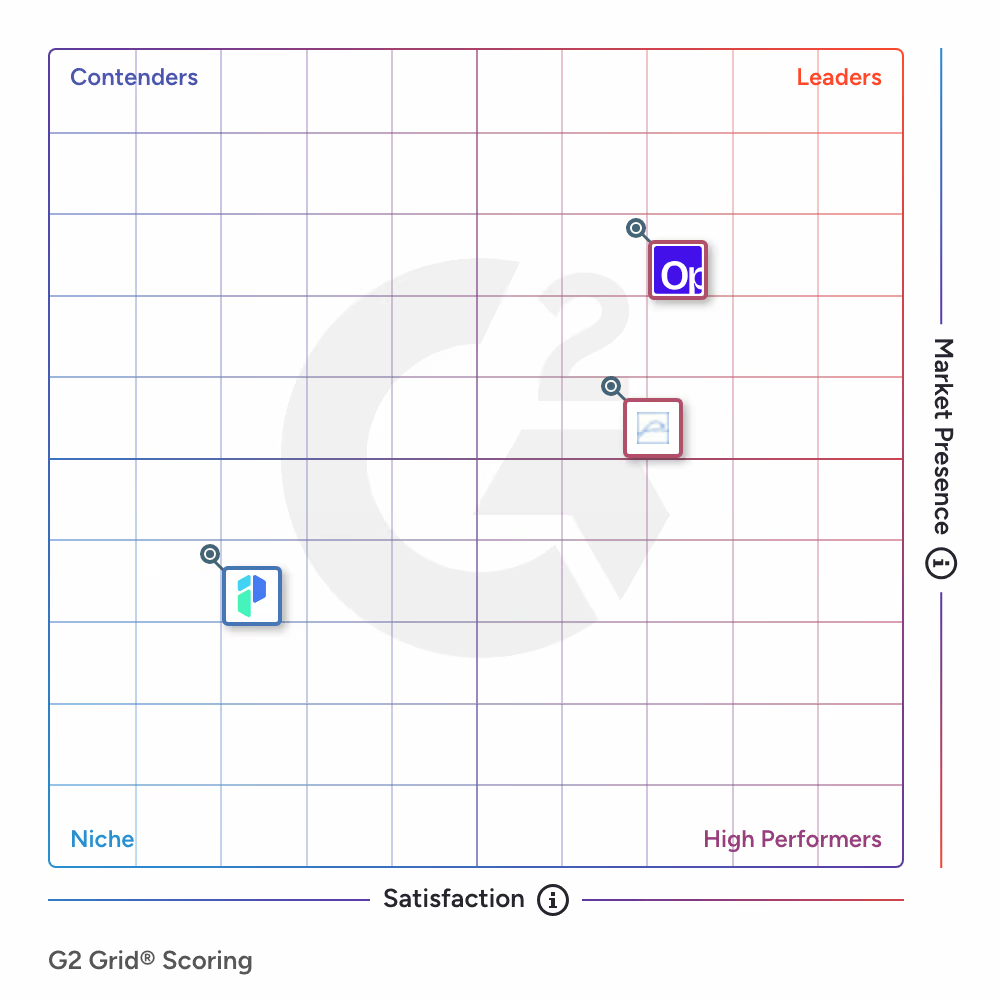
G2 Grid®
A Leader in presales management
The grid plots every vendor in the category on two axes: how satisfied their verified users are, and how much presence they have in the market. No analyst briefing buys a position on it. It moves when the reviews move.
“The UI and AI are amazing. We can now create complex POCs in seconds, compared to using spreadsheets. I also love how Opine helps us keep track of customer requests and bugs, allowing us to easily inform leadership about what's blocking our deals.”
Zach R.
Enterprise Account Manager
“From implementation to ongoing use, this tool stands out for its ease of configuration, intuitive interface, and seamless integration with common systems. Setup is straightforward, and connecting to widely used platforms is quick and hassle-free, reducing time-to-value significantly.”
Krystal Y.
Director, Engineering Operations
“Captures every single step of PoV motion (opportunity details, account teams, customer contacts, PoV templates, Task assignments, Scheduling, Report Generation, PoV statistics etc.), and then some. It's cloud-hosted, very easy to integrate with key systems like HubSpot, Slack, Gong etc. & their pre/post-sales teams are very responsive.”
Khurram W.
Technical Director - APAC
“Opine is very obviously made by SEs for SEs. I love that it incorporates data from Gong recordings, internal and external slack channels, salesforce, and more.”
Brian G.
Sr. Solutions Engineer
“Opine ties together the multiple tools I use daily to get my job done as a Sales Engineer effectively. Updates on meetings / sales process are provided in a single location and disseminated to other systems that consume that data. I spend less time inefficiently updating data in multiple places and more time on things that matter.”
Verified User
Computer Software
“The team at Opine is super genuine, listens to feedback, and generally implements features or fixes in days, not weeks, not months, but days!The user interface is really easy to use and super catchy! They have a nice workbench where you can see what you're focusing on right now and build custom filters.”
Ali F.
Solutions Architect
“It's built from the ground up by SE's for SE's on top of GenAI technologies and just works. It connects to all our tools seamlessly and they were willing to support additional needed integrations.”
Chris K.
FieldCISO, VP of CSM
“The responsiveness of the team to needs is amazing. Communication is outstanding. Navigation in the platform is smooth and fast.”
Charles K.
Solutions Engineer
The questions that actually come up
Taken from real evaluations where the other option was an internal build.
Have one we didn’t cover? Bring it to the demo
When does building in-house actually make sense?
For individual productivity, often. A leader wiring a personal dashboard on Claude Code, a small team sharing Claude Projects, a workflow whose whole context fits in a context window: build those, genuinely. The line is scope. Organizational infrastructure means every source connected, a deal model everyone trusts, and an owner in year two, and that is where the estimate breaks.
We've already started building. Is it too late to switch?
Keep the learning, retire the plumbing. What your team learned about your process, your criteria and your data is exactly what makes an Opine rollout fast, and the switching plan above is built around porting it. What doesn't port is the pipeline code, and that is the part with the year-two bill attached. Sunk cost is the wrong reason to keep paying it.
Can't we just point Claude or ChatGPT at our drive and CRM?
You'll get a search index. Deals aren't documents. Retrieval over files answers questions a folder can answer. A deal turns on things no single document states: what was promised, what's blocked, which criteria the buyer signed off, who stopped replying. Opine builds that opportunity-level record and serves it to those same assistants over MCP, and they get accurate the day it connects.
Wouldn't building it give us a moat?
Your moat is your product. This is plumbing. When buyers ask what Opine's moat is, our answer is the data architecture: the ETL and the normalized opportunity-level model that keep deal context current across every system. That work is real, unglamorous, and different in every org. For us it's the product. For you it's undifferentiated infrastructure that competes with the thing you actually sell.
What does the MIT number actually measure?
Deployment reached, self-reported, and the report says so. The sentence behind the hero stat reads: "In our sample, external partnerships with learning-capable, customized tools reached deployment ~67% of the time, compared to ~33% for internally built tools." The report notes the figures are self-reported and that the magnitude of the difference was consistent across interviewees. We quote the caveat because you'd find it anyway, and because two-to-one with a caveat is still two-to-one.
What happens to the person who brings Opine in?
In our experience, they get remembered for it. A pattern we keep watching rather than a promise we can print: because the layer serves every revenue team at once, the win is visible far outside the champion's own function, and it arrives in weeks instead of roadmap-quarters. Champions come out of the rollout looking like the person who saw it first. More than one has been promoted since, with the rollout on their review.
Are we locked in if we buy?
The record lands in systems you already own. Opine writes fields into your CRM rather than around it, context arrives in Slack and the forecast, and the MCP server makes the deal record readable by whatever assistant or agent you run next. The context layer's whole job is serving other systems. A layer that trapped context in its own UI would be failing at it.
How current is this page?
Every third-party line is dated and linked. The MIT figures are from the July 2025 report, linked where they appear. Every wall quote links to where it was said, and the build column is priced by the same public estimate our assessment runs on. If you spot something stale, email support@tryopine.com and we'll fix it.

