The Invisible Work Behind Every Technical Win
 Opine
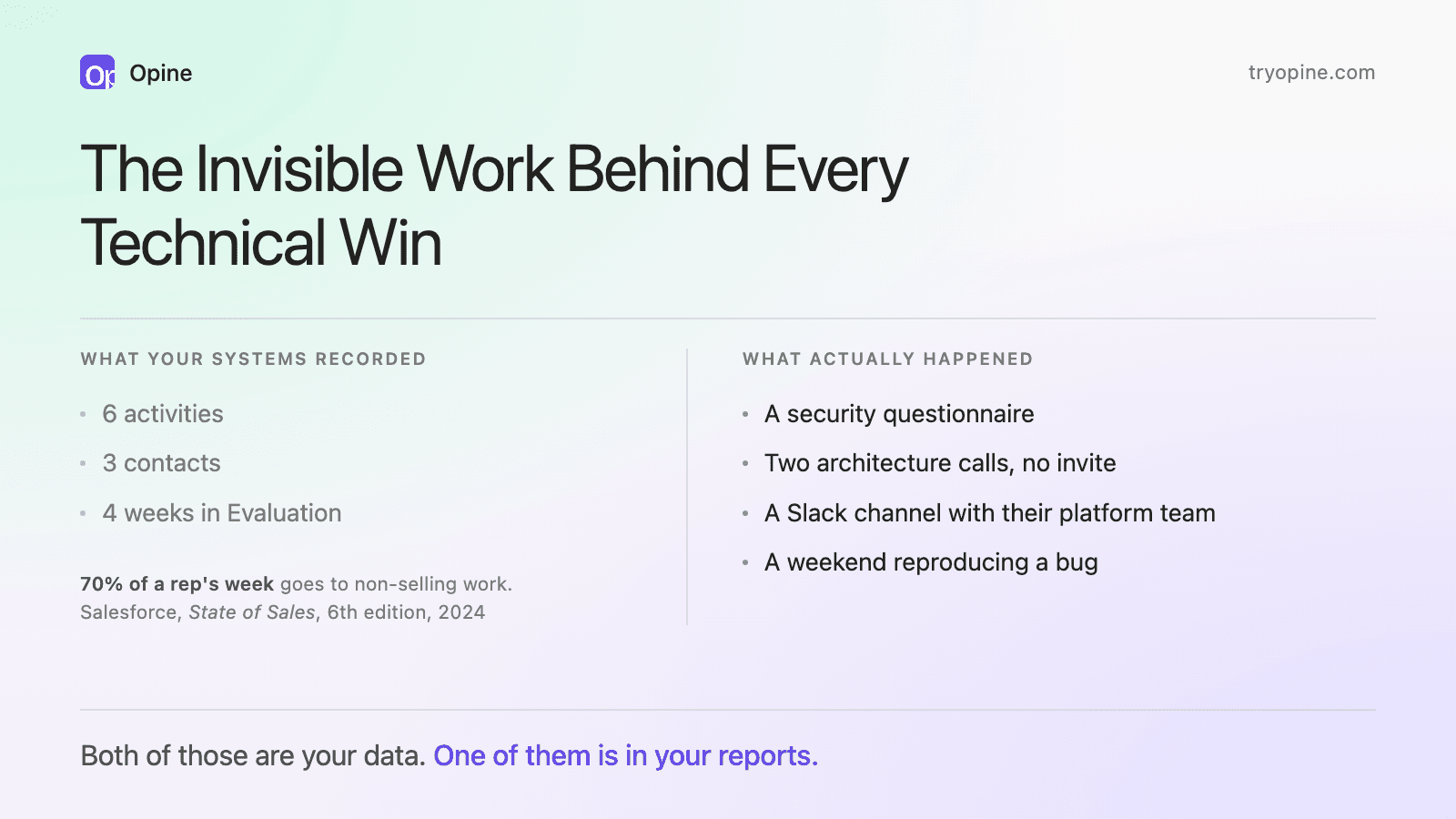
OpinePull up a deal you closed last quarter and rebuild it from your own systems. You will get a short list of activities, a few contacts, and a stretch of time in one stage.
Now ask the sales engineer who ran it what happened. You will hear about a security questionnaire, two architecture calls that never had a calendar invite, a Slack channel with the customer’s platform team, and a weekend spent reproducing a bug in their environment.
Both of those are your data. One of them is in your reports.
If you own the models the rest of the company plans with, this gap belongs to you before it belongs to anyone else. Capacity plans and attribution reports both read from the same record of what your team did, and that record is thinner than the work.
Is This a Logging Problem or a Capture Problem?
Most teams have already diagnosed this, and they have diagnosed it as compliance. People do not log. A PreSales Collective roundtable of presales leaders stated the working assumption plainly: “Not everyone reports their activities as expected, so a good data sample is obtained when 60-80% of the team members are effectively reporting.” The same group observed that “senior Sales Engineers disliked logging their activity” while “newer Sales Engineers tend to be better at logging.”
That reading is accurate. It also describes a different problem. The compliance frame assumes the only obstacle is willingness. Chasing the remaining share of reporting compliance still leaves the recording to a person who has to stop and do it.
Salesforce asked 5,500 sales professionals across North America, Latin America, Asia-Pacific and Europe how they spend their week. In the sixth edition of its State of Sales report, published in 2024, non-selling tasks, “such as administrative work and meeting preparation,” account for 70% of a rep’s time.
Part of that 70% is record-keeping itself. That is the point. The hours already going into recording are the hours available for it. Anything beyond that competes with customer work and loses.
Your CRM is doing the job it was built for. It holds opportunities, stages, amounts and close dates, and holds them well. The opportunity record is also the right destination for everything else. What is missing is anything that writes to it. A field for the hours a security review consumed takes an afternoon to add and then sits empty because filling it depends on someone choosing paperwork over the next call.
So a required-fields project cannot close this gap. Validation rules make an empty field mandatory rather than making the work visible, and they move the cost onto the person with the least time to absorb it.
Four Kinds of Work That Never Reach a Record
Four categories cover most of it. They differ in one way that matters for whether you can ever recover them: how much of a trace each leaves behind in a system you already own.
| The work | What trace survives | What it distorts |
|---|---|---|
| Calls without invites | A recording, if the call ran on your own conferencing account | Activity counts and utilization |
| Reading before an evaluation | Almost nothing | Why two similar deals took different effort |
| Coordination across teams | Slack threads and forwarded email | Stakeholder counts and close-date confidence |
| Validation inside a proof of value | The evaluation’s own artifacts | Technical win rate |
Row two is the honest exception. Preparation leaves so little behind that no amount of joining will fully recover it, and any claim otherwise is overselling.
Calls Without Invites
The scheduled demo has an invite, an attendee list and a recording. The rest has none of that. A sales engineer takes a fifteen-minute call to unblock an integration question. Someone runs a screen share at 7pm because that is when the customer’s engineer was free.
No calendar object means no activity record. Every downstream model treats the hour as time the team had free.
The Reading Nobody Logs
Before a technical evaluation starts, someone reads. The customer’s compliance framework, their architecture docs, the two competing products already in the environment.
Salesforce groups this with administrative work. That undersells it. Preparation on a complex deal decides whether an architecture call advances the evaluation or gets repeated next week, and the output is a sharper set of questions in someone’s head.
Coordination Across Teams
Complex deals need someone holding them together. Chasing a legal review. Finding the one person at your company who has seen this integration before. Rewriting a proposal after procurement changed the terms.
This is much of what a deal lead does in the final month and it produces Slack threads rather than records. It is also the first work dropped when someone is underwater, and dropping it stays invisible until a close date slips.
Ebsta and Pavilion analysed 4.2 million opportunities from 530 companies for their 2024 B2B Sales Benchmark Report. Won deals reached the solution-presented stage with nine contacts engaged; lost deals averaged two. Read that as correlation. The causal direction is genuinely open. A deal that stalls early never reaches the stage where more stakeholders would join.
Notice what the study could and could not see. It counted contacts because contacts are records. It could not count the work that turned two contacts into nine because that work lives in Slack. The most complete dataset in B2B sales can measure the outcome of coordination and not the coordination.
The Result Without the Run
A proof of value ends with a result: passed, or did not. Your systems keep the result. They lose the twenty tests behind it, the two that failed and got fixed, the criterion the customer added in week three.
Of the four, this is the work most directly responsible for a technical win. It survives in your data as a single field flipping to yes.
Why the Gap Is Worst on Your Biggest Deals
The claim worth arguing is about ratios rather than volume. Complex deals do not simply generate more invisible work. A larger share of their total work goes unrecorded. That is what makes the distortion directional instead of noise you can average out.
The two kinds of work scale on different curves. Recorded work grows roughly in step with formal process, and a larger deal genuinely carries more of it: more stages, more scheduled meetings, more approvals, more deal-desk and security review. Unrecorded work grows with stakeholder count and elapsed time together, and those multiply rather than add because each new stakeholder needs coordinating with everyone already involved, across a longer period.
If the second curve is the steeper one, the unrecorded share rises with deal size, and your measurement is least accurate exactly where your revenue concentrates.
That conditional is carrying the argument and has no published measurement behind it, including ours. Treat it as a hypothesis. It is also testable on data you already have.
How to Check This on Your Own Pipeline
Not with a multiplier. A single per-opportunity average assumes the gap is evenly spread. This argument disputes exactly that.
Take ten closed opportunities, five of your largest and five of your smallest. Reconstruct each one twice, once from your systems and once with the person who ran it. Count hours both times: hours your systems can evidence, and total hours the two of you can account for.
That gives you an unrecorded share per deal: the difference between the two totals, divided by the total. Then compare the five large against the five small. The share tells you how wrong your capacity model is. The comparison tells you whether the gap is directional or whether you can safely treat it as noise.
Ten deals and one interviewer is a small, rough instrument. It is also the same instrument every capacity model in your company is already using, run once deliberately instead of never.
What Breaks While the Record Is Incomplete
Two models read this data directly, and both fail in the same direction: they understate the work and therefore the need. One turns into a staffing decision and the other into a budget decision, and neither failure announces itself at the time. The cost surfaces a quarter or two later, in numbers nobody connects back to the record they came from.
Capacity Planning
Capacity planning divides recorded work by available hours. When a large share of the work was never recorded, the answer comes back reassuring and wrong.
Set your own utilization target and consider a report that clears it comfortably against a team that cannot absorb another deal. Those two facts cannot both be acted on. The engineers know which one is right, and you hear it as complaints about workload. Complaints do not survive contact with a spreadsheet showing headroom.
So the plan says hire nobody. The team absorbs the difference by dropping coordination work, the least visible thing they do, and the cost arrives two quarters later as slipped close dates.
Revenue Attribution
Attribution runs on recorded touches. A function whose work is not recorded appears in the data as uninvolved in the revenue it produced.
The engineer who ran the winning evaluation shows up as an attendee on a couple of meetings. The account executive shows up on every call that had an invite. Any model built from that data concludes the deal was won by whoever booked the most calendar time. Presales impact rarely survives a QBR on its own numbers.
Then the same data feeds next year’s investment model. Under-recorded work gets less credit, then less budget, then less headcount.
What Changes When the Work Has a Record
None of this asks your team to log more. Requiring people to record work they are already too busy to finish is how the last attempt died, and the one before it.
The signal exists, scattered across the systems in the table above: Salesforce, HubSpot, Gong, Zoom, Slack, calendar, email, tickets, documents. Joining it to an opportunity is the step that never happened and it is the whole job.
Opine sits underneath the AI and reporting you already run. It assembles that scattered signal into centralized deal context and writes the result onto the opportunity. That is what CRM hygiene means here. The distinction from a required-fields project is the direction of effort. Fields fill from interactions your team already had instead of from a person deciding to type.
Revenue teams spend roughly half their time hunting for context and updating tools. That is the half this is aimed at.
The questions it opens up are the ones you could not previously ask. Which opportunities consumed the most specialist hours last quarter, which stages absorb time without moving win rate, which deals your team supported and lost. Ask Opine answers those in plain language and traces every answer to the record it came from. What you get is rows you can open rather than a number you have to trust.
The two models from earlier get their own surfaces. SE utilization and team activity shows where presales time went and where the team is stretched. Win/loss reporting explains why deals closed and why they slipped from deal data rather than from recorded touches.
One number matters more than any of that. Gainsight tripled its closed-won dollars per sales engineer hour. Read it as a measurement result before an efficiency one. Computing dollars per sales engineer hour at all requires knowing where the hours went. That is the capability most teams are missing, and dollars per hour is the currency capacity planning was always trying to estimate.
Take ten deals and reconstruct them twice. By the end of the week you will know whether your capacity model describes your team or describes the paperwork your team had time to finish.