Revenue Agents That Run in the Cloud, on Context You Can Trust
 Opine
OpineEvery revenue team has a list of work everyone agrees should be automated, and never is.
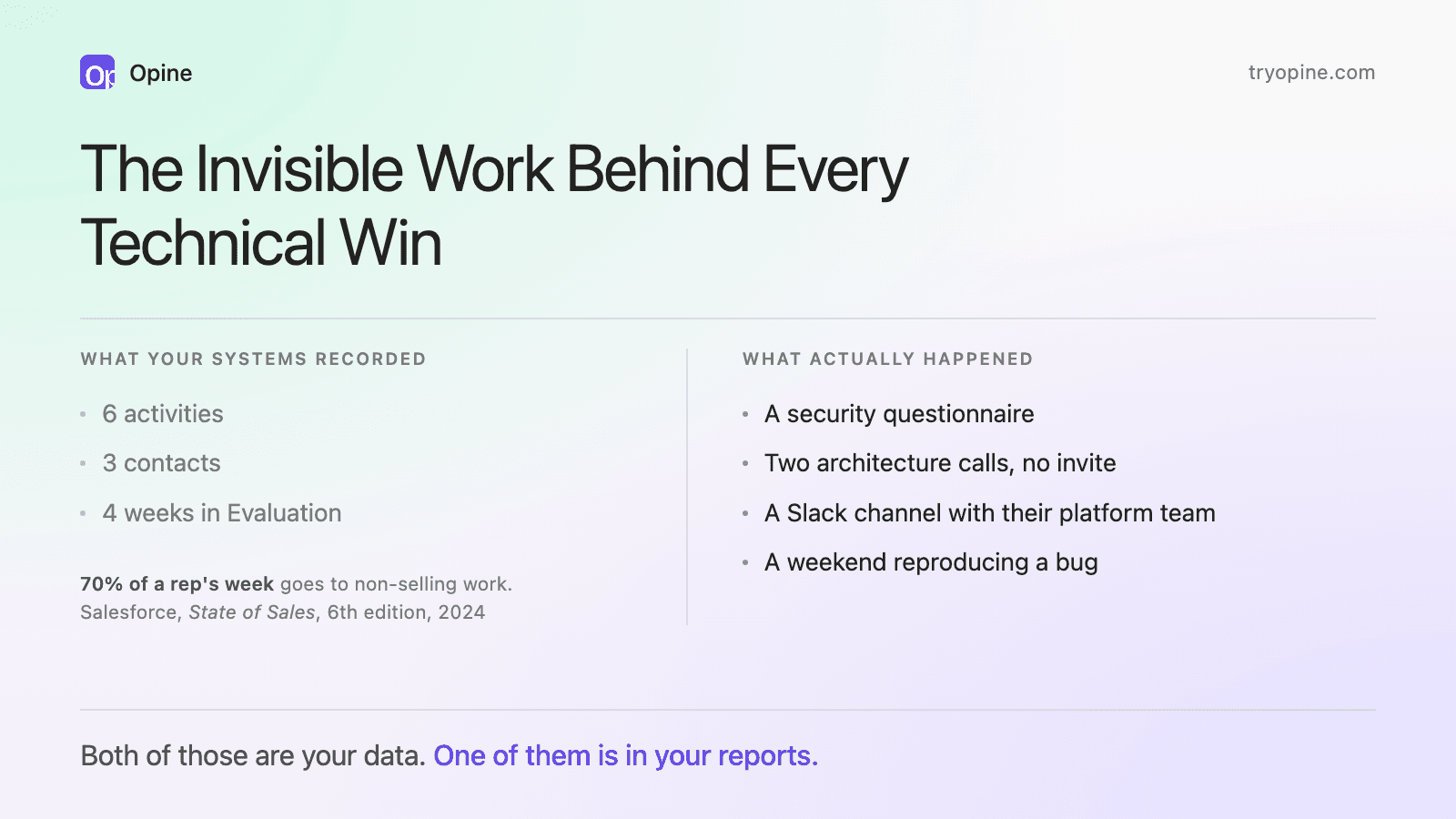
The Monday pipeline digest somebody assembles by hand. Checking which evaluations have stopped moving. Writing the handoff document when a deal closes so post-sales inherits more than a closed-won stage. Catching the competitor mention that surfaced on a call nobody had time to review.
None of it gets automated, and the reason is specific: this work needs judgment and it needs context. Rules can’t do it. “Alert me when a deal stalls” requires knowing what stalling looks like for this deal, at this stage, with this buying committee. And the tools that are good at judgment don’t know anything about your deals.
So it gets done by hand. Or, increasingly, it gets done by one person.
The workflow on somebody’s laptop
You probably have this person. Usually in RevOps, sometimes a technically-minded SE leader. They wired something together: a script, a local AI tool, an MCP connection into a few systems. Now every Monday it produces the summary the whole team reads.
It’s genuinely impressive, and it’s genuinely fragile.
It runs on their machine, so it runs when they’re online. Using it means inheriting a folder of scripts, which is why nobody else does, and why every refinement routes through one person. Then they change teams and it leaves with them. What’s left is a report nobody knows how to regenerate.
This is the state of the art for automating GTM work right now, and it’s a dead end. The person didn’t do it wrong. A laptop is just the wrong place for infrastructure the whole team depends on.
None of this is hypothetical for us. It’s the pattern we kept finding in the revenue teams we work with, and it’s why we built Opine Agents.
Agents that run in the cloud. On a schedule, or the moment something changes on a deal. They belong to the organization rather than to a person, and they keep running whether anyone is at their desk or still at the company.
Agents that know what job they’re doing
Today, the Agent Template Library ships with nine, and we plan to add to it regularly. Where this is going is a library that covers most of what a revenue team needs out of the box, which you then customize for your own workflows. What’s there now covers the jobs that come up on nearly every team:
Watching deals: Risk Scanner surfaces stalls and champions who have stopped replying, while there’s still time to act. Buying Signals flags the moments that indicate real intent. The Negotiation & Objection Tracker keeps a running picture of what’s actually being contested.
Keeping the record current: Post-Call Follow-up Draft turns a conversation into the email you were going to write anyway. Product Feedback Capture notices a feature gap in a call and routes it to your product team with the revenue attached.
Running the process: POC Kickoff assembles a proof-of-value plan when a deal reaches technical validation. My Deal Focus tells an individual contributor what needs their attention today.
Seeing the whole picture: Weekly Reporting Digest sends leadership the deals and risks that matter, on a cadence you set. Cross-Deal Win/Loss Analysis finds the pattern across a quarter rather than one opportunity at a time.
Start from one of those, change what it watches and what it does, and it’s yours.
You’ll build your own, and that’s the point
The library covers common jobs. But we know the way every team operates is unique.
The way your team defines a qualified opportunity, the three things that always go wrong in week two of a POC, the specific escalation path when security review stalls. None of that is in a template, and it shouldn’t be. For a long time to come, the agents that matter most to your team are the ones your team builds.
That gap is the product.
What Opine provides isn’t a fixed catalog you eventually outgrow. It’s a proven way to build: describe what the agent should do in plain language, give it the tools and the Skills it needs, choose what triggers it, test it against real deals before it touches anything, and turn it on. The library is a set of worked examples for that process: nine demonstrations of what a good agent looks like, not nine things you’re limited to.
The teams getting the most out of this treat agent-building as a standing capability rather than a project. One or two people build; everyone benefits.
Why they work here
Whether any of this is real has nothing to do with agents.
An agent is only as good as what it knows. Point a capable model at a CRM export and it will produce plausible, confident, wrong answers. What it needs is scattered across the call nobody transcribed, the Slack thread in a channel it can’t see, and the requirement someone captured as free text in a field that has since been renamed.
Opine is already connected to the places that data lives: Salesforce, HubSpot, Gong, Zoom, Slack, calendar, email, tickets, docs. More importantly, it doesn’t just collect it. It normalizes it into a structured, current picture of each deal: who the stakeholders are, what was committed, what’s blocking, what changed this week.
That’s years of unglamorous work, and it’s the reason agents here can do something agents elsewhere can’t. When an Opine Agent needs to know something, it doesn’t infer from a pile of text. It queries. Opine SQL gives agents the same structured, permission-aware access to your deal data that your analysts have. Ask an agent which evaluations lost momentum this month and it can actually answer, because the question is answerable against real data rather than a guess assembled from context windows.
If your team adopted Opine for presales, this is the return on that investment. Every requirement logged, every criterion scored, every call attached to the right deal — that was the foundation. This is what it was for.
Why they keep working
Getting an agent to behave correctly once is a demo. Keeping it correct is the engineering problem, and it’s where most agent projects fail: the model changes underneath them and nobody notices the output got worse.
Two things address that.
You can build evals. Define what a good run looks like for your agent, and its live runs get scored against that standard.
The more useful half is that you can dry-run a change before committing to it. Take a set of real historic runs, push them through the modified agent, and inspect the outputs. You find out whether a new instruction actually improved anything without a live deal being the experiment. Prompt changes stop being a leap of faith.
This is the same practice behind our own AI: thousands of evaluations gate every change and every model upgrade before it reaches anyone. Now you can define your own, for the agents you build.
Agents operate inside your permissions. An agent working on someone’s behalf sees exactly what they see and nothing more. Every action it takes is recorded, and anything high-stakes waits for a person to approve it. An agent should be accountable in the way a person is, and this is what that means in practice.
What changes
For as long as GTM has existed, capacity has scaled with headcount. Want more pipeline hygiene, more proactive risk management, more consistent POCs — hire more people, or accept that it won’t happen.
Agents change the arithmetic. The work your team encodes once keeps running, needs no onboarding, and gets better as you refine it. What your revenue org can do stops being a function of how many people it employs.
It only works if the agent can be trusted with real deals. Which is why the context layer had to come first, and why we spent years on it before we shipped this.