Why Presales Still Can’t Prove Its Impact (And How to Fix It)
 Opine
OpineTechnical sales teams carry the most complex deals,and run 10 times the demos. Yet technical sales leaders walk into QBRs with less budget, thinner comp and minimal board visibility. This is the story we hear from all the SE teams we’ve interacted with.
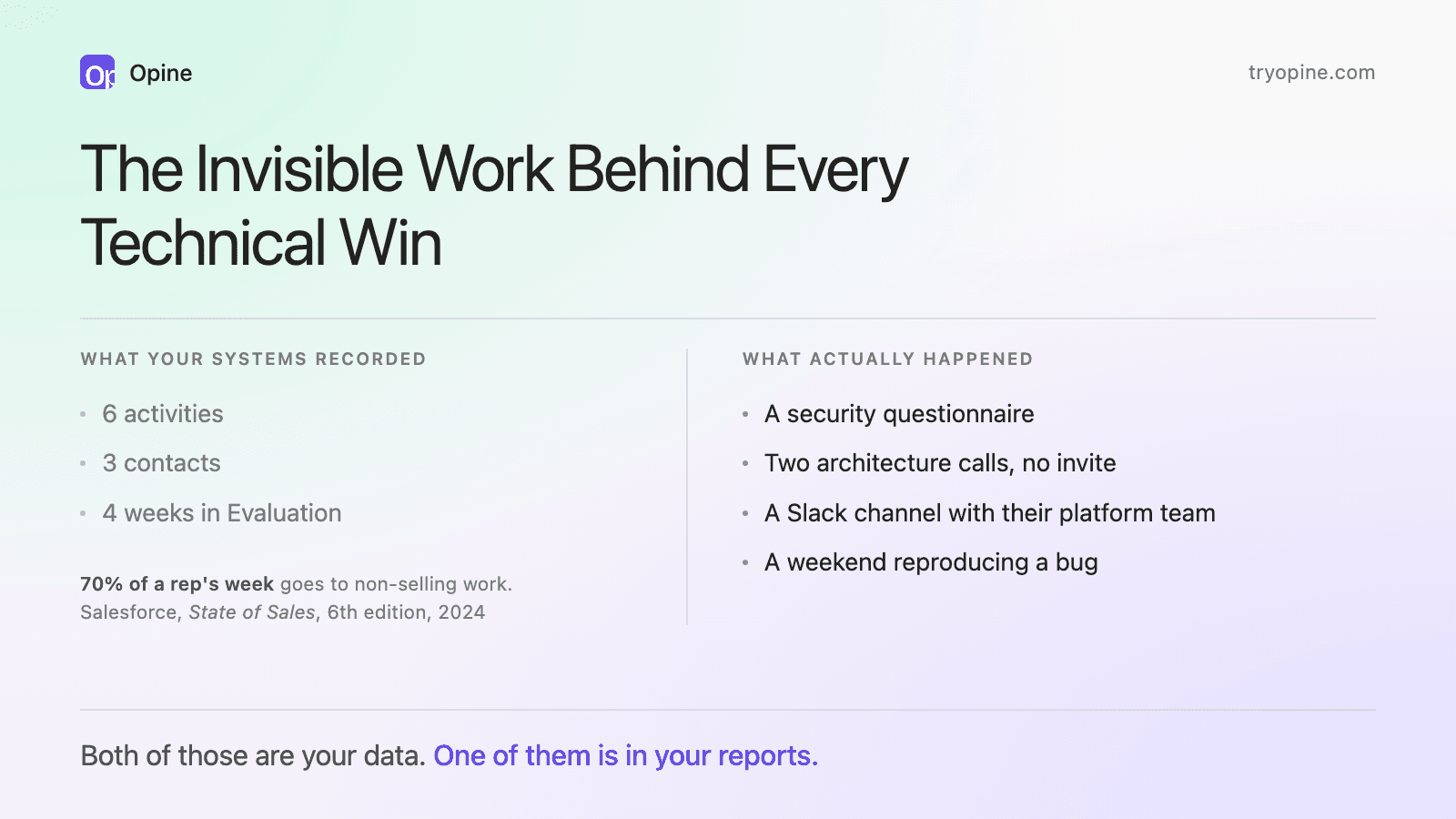
Though companies use CRM for their reporting it doesn’t show the full picture. CRM reports show owners, stages, and amounts, but they hide the volume and depth of SE work that actually moves complex deals forward.
McKinsey study concluded that B2B companies that build data driven sales engines outperform peers on growth and profitability by 25%, yet most presales teams still operate in a fragmented data reality.
The problem is not narrative or skill. The problem is that your data does not show the full story of presales’ impact.
The presales problem is a lack of visibility and metrics
Every time we speak to a prospect about their current technical sales process this is what they say:
- “Everything gets lost in Slack.”
- “I have a separate Google Sheet to track this outside of Salesforce, but it gets overwhelming to do it for multiple calls and ask your people to fill out details.”
- “We are living in a combination of Confluence, Google Drive, Google Sheets, Slack.”
- “We need a central place that is consuming information from Slack, Gong, Salesforce, Jira to show our work.”
- “I need data to justify headcount and SE compensation.”
- “I want leadership to have line of sight into our paid pilots to show my teams’ impact.”
Does this sound familiar?
Most CRM and pipeline views track opportunity owner, stage, and amount, but they ignore the volume and quality of SE work that keeps those deals alive. Discovery workshops sit in calendar events. PoCs live in shared drives. AEs pull presales teams into multiple deals without any standardisation increasing workload. Security reviews stay in email threads. None of that appears in standard revenue reports.
Data shows that when companies use analytics on interaction data across deals, they see clear behavior patterns that help them win more often. That same logic applies to SE work. If the system never connects SE interactions to outcomes, the team stays invisible at exactly the moment you need air cover for headcount and comp.
You can see the disparate data problem play out in QBRs. Sales leaders walk through closed deals and the big bets for the next quarter. SE leaders need to explain impact, and if your team is at capacity. The lack of clean utilization, influence and technical wins secured is often under-reported. The room moves on and processes or headcount conversations get pushed to later.
Four metrics presales leaders should track to prove their impact
Once you see how much SE work sits outside Salesforce and QBR decks, the next question is simple: what should you actually measure?
You do not need 30 metrics. You need four that connect SE work to business outcomes.
1. Utilization
Utilization measures how much of an SE’s working time goes to deal-supporting activity: discovery, demos, PoCs, security reviews, customer calls. Track it as a percentage of available hours.
Utilization tells you two things. First, whether your team has bandwidth for new work. Second, whether you have a capacity problem you can defend with data when you ask for headcount. A team running at 95% utilization for two quarters straight is not a team that needs better prioritization. It is a team that needs another person.
Track customer-facing hours per week against a realistic target. You need to know where your teams’ time is spent. Over a quarter, this tells you whether the team is underused or operating at sustained peak load, which you can then bring into headcount and coverage discussions.
2. Capacity balance
Utilization across the team does not tell you the full story. You also need to see how work is distributed across individuals.
Look at SE-to-AE ratios and SE coverage across regions, segments, and product lines. When you line that up with performance data, you can see where low SE coverage correlates with lower win rates, slower cycles, or stalled expansions.
Capacity balance shows you whether two SEs carry 70% of the demos while four others carry 30%. That imbalance burns out your top performers and hides your real coverage gaps. When a top SE quits, you do not just lose one person. You lose the person who was holding three regions together and their tribal knowledge.
3. Deal influence
Deal influence connects SE activity to opportunity outcomes. For every closed deal, what SE work happened on it? How many demos? How many PoC days? How many technical calls?
This is the metric that translates SE work into revenue language.
When you can show that deals with two or more SE-led PoCs close at 60% versus 25% for deals without, you have a number a CFO understands. It also tells you which SE motions matter and which are noise.
Over time, this view also tells you where to focus the team. If SE involvement in early discovery lifts win rate more than late stage firefighting, you have a data backed case to push for earlier SE engagement and to redesign the AE-SE handoff.
If extended PoCs do not change outcomes in certain segments, you can shorten or standardize them and give that time back to the team.
Deal influence becomes the bridge between day to day SE activity and the metrics RevOps and finance care about: win rate, ACV, and cycle time. It lets you say, with evidence, when SEs show up in this way on these deals, the business gets this result, which is the level of clarity you need in any headcount, coverage, or comp discussion.
4. Win rate by SE
Win rate by SE shows you which SEs win the deals they touch. When one SE wins 70% of their deals and another wins 35%, that gap usually traces back to specific behaviors: how they run discovery, how they scope PoCs, how they handle objections.
Win rate by SE turns those behaviors into a coaching pipeline. You can review deals with high win rates and ask:
- How did this SE structure discovery and qualification?
- What did their PoC scope look like compared with peers?
- How did they use product, PM, or post sales to de-risk the decision?
Those answers become playbooks, talk tracks, and enablement content you can roll out across the team, not just tribal knowledge that sits with one person. Forrester notes that high impact sales organizations put sustained coaching at the center of their productivity strategy; they do not leave performance to a few star sellers. Win rate by SE gives you a starting point for that coaching in presales.
But can you capture all this data manually?
Manual logging and spreadsheet tracking always sets in fatigue
“I have a separate Google Sheet to track this outside of Salesforce, but it gets overwhelming to do it for multiple calls and ask your people to fill out details.”
This is what an SE leader told us when they tried tracking metrics and their work with spreadsheets. Spreadsheets work for two weeks.
The pattern repeats: you roll out a tracker, the team fills it in for the first sprint, then logging gets thinner. By week six, half the team has stopped. By week ten, the data is so patchy you cannot use it.
Manual logging fails because it puts the cost of data collection on the people doing the work, and they get no value from it. An SE who just spent 90 minutes on a discovery call is not going to open a spreadsheet and tag the call against an opportunity. They are going to write the follow-up email and move to the next call.
Everest Group’s B2B sales services research also points out that leading providers differentiate by using AI and analytics to improve CRM hygiene and funnel visibility for sellers. That is the direction presales leaders need to mirror inside their own stack if they want consistent, trusted metrics.
Automated activity capture: what it looks like when the data just shows up
The fix for getting better data is taking the human out of the data collection loop.
Automated activity capture pulls SE work from the systems where it already happens. Calendar events become tracked discovery sessions and demos. Email threads tied to opportunities become logged interactions. PoC environments and shared drives become artifacts attached to deals. Slack channels with customer engineers become threads of technical work the SE drove.
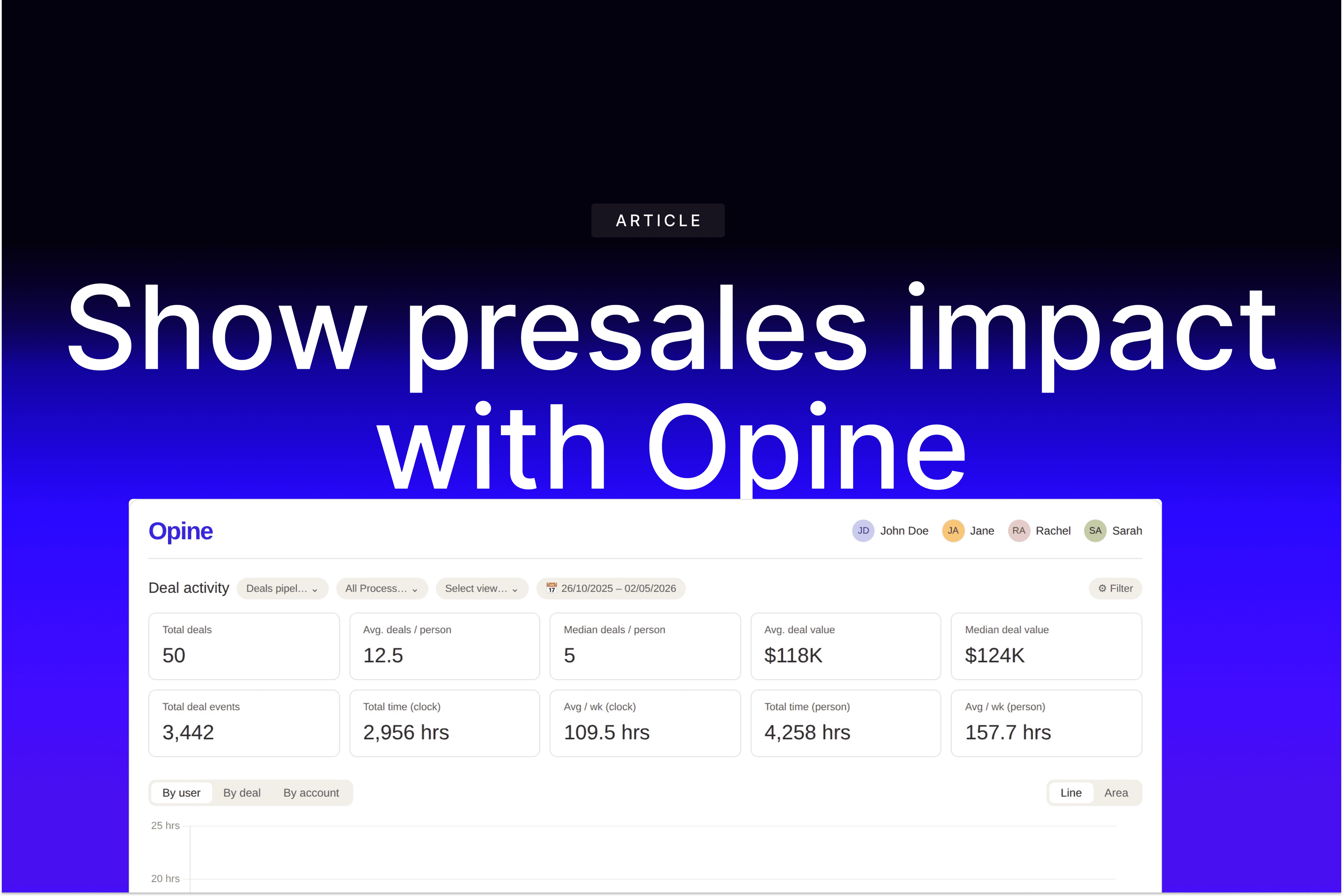
With Opine, presales teams’ are able to put together reports in 30 mins, not a week of leaders scrambling for the right metrics siloed across tools.
All teams have clarity and insight into what’s happening across the pipeline in real-time after every customer interaction.
Opine’s AI agents make this process more automated.
- AI agents that auto-classify SE meetings and demos.
- Agents that extract technical requirements, constraints, and objections from call recordings and notes and take actions across systems or send notifications on Slack.
- Agents that update CRM and RevOps systems in the background so SEs and AEs do not spend hours on admin.
- Agents that help coaching your SEs based on past conversations
Opine pulls from the tools your team already uses. Salesforce, HubSpot, Slack, Gong, Zoom, Jira, Linear, Google Drive, calendar. Every deal in your pipeline gets a unified, proactive, and continuous view on what’s happening.
What changes when the data shows up
Once the data is in your hands, we’ve seen three important conversations get easier for our presales leaders:
Headcount conversations: Your headcount ask used to sound like a feeling. Now leaders can frame it this way “Our team ran at 92% utilization for the last two quarters. Deal influence data shows we declined SE support on 14 opportunities worth $4.2M in pipeline because we ran out of capacity. Having 3 additional SEs will pay back in one quarter”.
Turning tribal knowledge into team-wide coaching: Every SE team has two or three people who consistently win the deals they touch. The way they run discovery, scope a PoC, or handle a security objection lives in their head. When they leave or get pulled into another region, that knowledge walks with them.
Win rate by SE and deal influence give you a way to find those patterns and pull them out. You can see which SEs win the deals they touch, then look at what they actually did: how they framed discovery, where they pushed back on scope, which stakeholders they pulled in early, how they de-risked the technical evaluation.
Those patterns become playbooks, talk tracks, and PoC templates the rest of the team can run. New SEs ramp on what already works instead of figuring it out deal by deal. A senior SE leaving the team stops being a single point of failure.
The same data also tells you where to coach. If two SEs have similar deal volume but very different win rates, you know where to spend your 1:1 time and what to focus on. Coaching stops being a feeling about who needs help. It becomes a decision based on what the deals show.
Board visibility: Opine’s customers see C-suite getting a full picture of the deals. When presales leaders can show stakeholders that 70% of enterprise revenue from last quarter was through SE-led PoCs, presales no longer becomes an in-between function.
Parting thoughts
Technical sales teams already do the work. They run the demos, the PoCs, the security reviews, the discovery sessions that turn complex deals into closed revenue. The challenge is to make that work visible in the systems where decisions about budget, comp, and headcount actually happen.
Opine is an AI-first technical sales platform for revenue teams. Our AI agents proactively and continuously converge scattered deal context and tribal product knowledge into real-time deal intelligence for your revenue teams. SE work that lives across Slack, Gong, Salesforce, calendar, email, and the rest of the stack gets pulled into one place and turned into metrics every SE leader needs to walk into a QBR.
No more updating spreadsheets. Chasing your teams to update CRM or to log their activity manually. Automate your presales processes end to end with Opine.